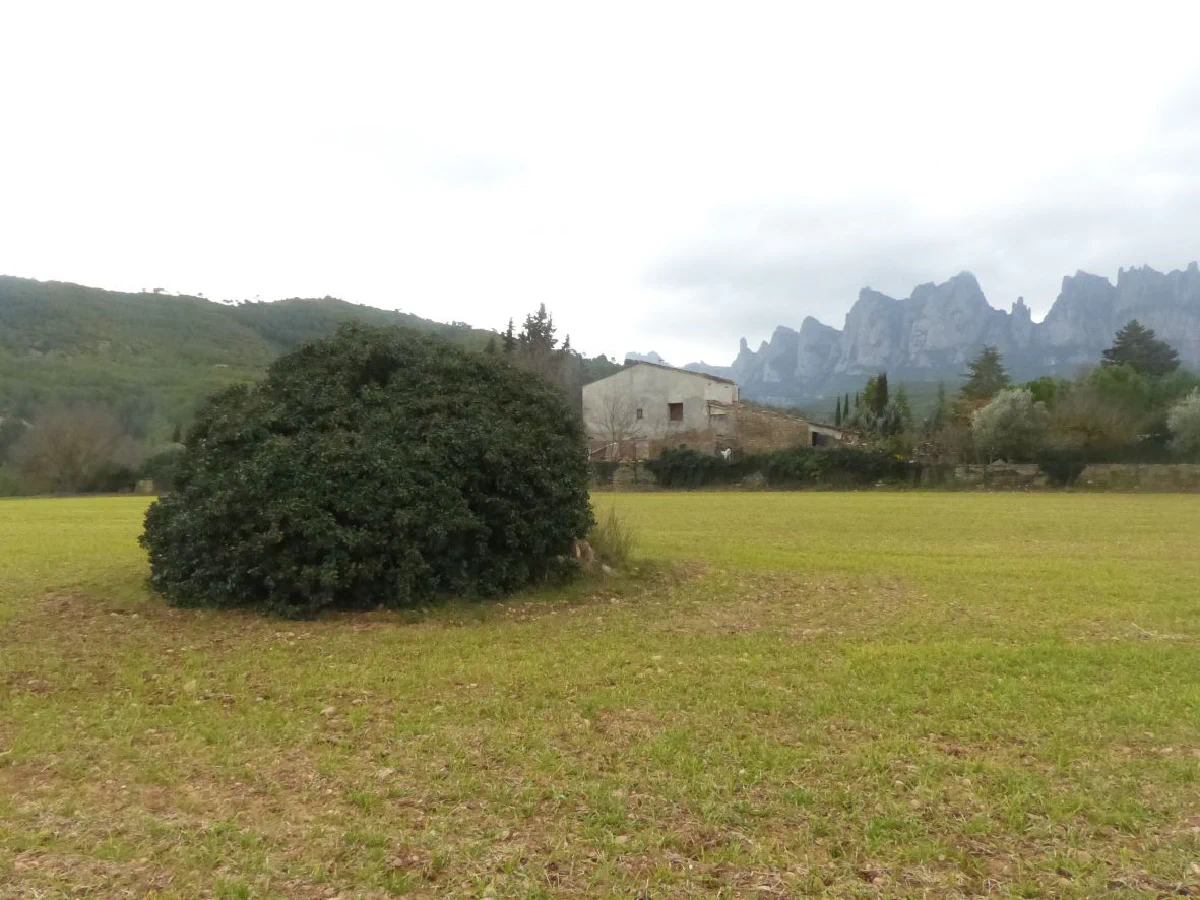
There is surprisingly little written about Cal Penedes. The only source I have found that mentions it directly is a short entry on the wonderful Topònims de Castellbell i El Vilar blog, which catalogues the place-names of our municipality. It says, essentially, three things:
- Cal Penedes is a mas (a traditional Catalan farmhouse) in the terme de Sant Cristòfol, at the southern end of the Pla del Mas Roig.
- It was formerly called Puig Nou — “new Puig”.
- It got that name because it was a mas aglevat: a cadet farmhouse split off from the nearby Mas Puig, which today is known as Mas Prat.
That last point is the interesting one, because Mas Puig / Mas Prat turns out to have a very long paper trail. Following the same blog’s entry on El Prat, the lineage goes roughly like this:
- 1251 — first documented as Mas Puig, held by a certain Bernat Puig. This is the earliest date I can tie, however indirectly, to the ground Cal Penedes sits on.
- c. 1400 — the house appears in documents as Puigrich.
- 17th century — it is called Puig de Llor or Puig del Llorer.
- 1598 — Magí Puig, from this Mas Puig in Sant Cristòfol, marries Margarida, widow of Salvador Ferran, and inherits the Mas Ferran down in El Vilar. Over the following century and a half that house gradually becomes known as El Puig del Vilar. (There is even a whole book about it: Joan Valls i Pueyo, El Puig del Vilar. Vuit segles d’història mirant a Montserrat (Castellbell i el Vilar, segles XIII–XXI), Zenobita Edicions, 2015.)
- Early 19th century — the original Sant Cristòfol house passes to the Prat family and is renamed once more, this time to Mas Prat, the name it still carries.
- Late 1970s — most of Mas Prat’s land is carved up and sold off as the Can Prat urbanisation, which today sits between us and the village.
Cal Penedes itself does not feature by name in any of that. The most we can say is that, as Puig Nou, it was at some point peeled off from whichever of those names the mother-house happened to be using at the time — most likely in the 17th or 18th century, when cadet branches of large masos in this area were commonly being set up on their own plots. The change from “Puig Nou” to “Cal Penedes” is undocumented, at least as far as I can find; the “Penedès” surname presumably arrived with a later owner, but I have not been able to pin down who or when.
How old is the house, then?
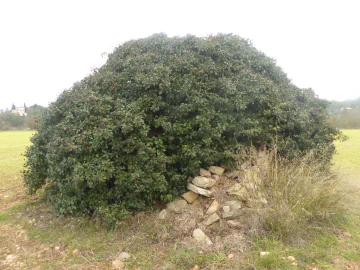
No surviving document puts a date on Cal Penedes directly, but three pieces of evidence line up surprisingly neatly. First, the 1553 fogatge for Sant Cristòfol lists the old masies of the hamlet — Enric, Plaià, Carner, Pujol, Ferreroles Vell, El Prat, El Ros — and Cal Penedes / Puig Nou is not among them, so it almost certainly did not yet exist as an independent mas in the mid-16th century. Second, the very name Puig Nou (“new Puig”) is only consistent with a split while the mother-house was still being called something Puig-based — Mas Puig, Puigrich, or Puig de Llor — which stops being true once it is renamed Mas Prat in the early 19th century. And third, the catalogued dry-stone barraca 50 m from the front door is dated by the patrimoni cultural survey to the 18th–19th century, tied to the wine-boom expansion of the second half of the 1800s; whoever built it was already farming these fields from very close by.
Taken together, the most plausible window is a foundation somewhere in the late 17th or (more likely) 18th century. In round numbers, that makes Cal Penedes roughly 250 to 350 years old. Older than that, and it ought to appear in the 1553 list; much younger, and “Puig Nou” would not have stuck.
Some wider context that helps situate the place:
- Sant Cristòfol is a veïnat, a scattered hamlet on the northern slope of Montserrat, in the western part of Castellbell i el Vilar. Its Romanesque church of Sant Cristòfol dates from the 11th century, was heavily modified in the 17th, and was restored in 1981.
- A 1553 tax document (fogatge) for the hamlet lists the masies Enric, Plaià, Carner and Pujol; among the oldest are also Ferreroles Vell, El Prat and El Ros. Cal Penedes / Puig Nou is not mentioned, which is consistent with it being a later offshoot.
- The Pla del Mas Roig — the big cereal field stretching away from our front door and the largest cultivated plain in the whole municipality — is bounded by the Torrent del Carner to the west and the Torrent del Prat to the east, and is cut in half by the old path from Sant Cristòfol up to Marganell. It was once planted with olive trees. The name comes from a Mas Roig that has since disappeared entirely; judging from the toponims blog’s entry on the Balma dels Pobres, it most likely stood on the far north-west edge of the plain, right where the land drops to the Carner stream.
- Our nearest structure in the field is the Barraca del pla del Mas Roig, a circular dry-stone shelter about 50 m north of the house. It is catalogued in the Diputació de Barcelona’s cultural heritage database, which dates it to the 18th–19th century and links it to the wine-boom years of the second half of the 1800s. It has a corbelled stone vault and an east-facing door, though by now the whole thing is so overgrown with ivy — “branches as thick as a fist”, per the catalogue entry — that you can barely tell it is there.
- At the other end of the plain, roughly 750 m to the north, sits Cal Macari, the neighbouring masia. The name is simply a personal name, from the Latin Macarius (and Greek μακάριος, “happy”).
If anyone reading this has more — old deeds, family stories, a mention in a parish register — I would love to hear from you. For now, this is as much as I have been able to dig up.
Sources
- Topònims de Castellbell i El Vilar — Cal Penedès
- Topònims de Castellbell i El Vilar — El Prat
- Topònims de Castellbell i El Vilar — El Puig
- Sant Cristòfol (Castellbell i el Vilar) — Viquipèdia
- Barraca del pla del Mas Roig — Mapes de Patrimoni Cultural, Diputació de Barcelona
- Joan Valls i Pueyo, El Puig del Vilar. Vuit segles d’història mirant a Montserrat (Castellbell i el Vilar, segles XIII–XXI), Zenobita Edicions, 2015.
- Joan Valls i Pueyo, Les llibretes del mas Puig del Vilar. Dietaris de pagès a Castellbell i el Vilar (segles XIX–XX), Ajuntament de Castellbell i el Vilar, 2004 (col·lecció Temes històrics, II).
- Joan Valls i Pueyo, “El mas Llopart (després Ferran) i el mas Ferran (després Puig del Vilar)”, El Brogit, núm. 159, setembre 1993, pp. 8–9.